

GAIA is a decentralized compute infrastructure that enables anyone to create, deploy, scale, and monetize personalized AI Agents. Through globally distributed Gaia nodes, developers can run custom AI Agents in minutes—complete with OpenAI-compatible APIs and a web chat UI—while plugging in open-source LLMs and bespoke knowledge bases to eliminate generic answers. It’s incentives and on-chain governance ensure node reliability and data privacy, providing an auditable, autonomous, high-performance inference layer for Web3 AI apps. This Token Insights article analyzes It across six dimensions—project positioning, core technologies, tokenomics, ecosystem progress, risk management & mitigation, and future roadmap—to fully capture its growth potential.
Abstract: GAIA builds a distributed AI Agent network supporting custom LLM inference and knowledge-augmented generation; the GAIA token powers staking, governance, and payments; mainnet is live with Mira integration—next up: domain-as-node and cross-chain incentives.
Project Positioning: Decentralized AI Agent Infrastructure
GAIA aims to be the “AI Agent operating system” of Web3, giving developers and individuals a decentralized platform to create and run AI Agents. Each Gaia node runs a high-performance WasmEdge runtime, loads fine-tuned open-source LLMs, and connects private knowledge bases to offer an OpenAI-alternative inference service. On-chain staking and governance keep nodes stable, while market dynamics reward top-performing Agents.

Core Technologies: Multi-Layer Inference Engine & Node Incentive Protocol
GAIA’s tech stack includes:
-
WasmEdge Runtime: lightweight, secure, efficient local inference on CPU/GPU/AI accelerators;
-
Open-Source LLM & KB Integration: choose from Llama 3, DeepSeek, etc., and mount custom knowledge bases for RAG;
-
Distributed Node Network: operators stake tokens to earn inference rights; each inference logs SLA data on-chain for rewards and penalties;
-
OpenAI API Compatibility: drop-in replacement to minimize migration effort.
Flow: Node Registration → Model Load → Knowledge Retrieval → Inference → On-Chain Reporting → Reward Release, ensuring transparency and decentralized security.
Tokenomics: Staking, Payments & Governance
GAIA token is the economic hub. Per CoinGecko, total supply is 1 billion, ~170 million circulating, used for:
-
Node Staking & Service Reservation (50%): stake GAIA to report inferences and earn SLA rewards;
-
API Call Payments (30%): applications pay GAIA per inference, fees split per preset ratios;
-
Ecosystem Fund (15%): supports hackathons, SDK development, and community growth;
-
DAO Governance (5%): holders propose and vote on protocol changes.
Dynamic staking and distribution models allocate resources fairly, while the DAO prevents governance centralization.
Ecosystem Progress: Mainnet Launch & Partnerships
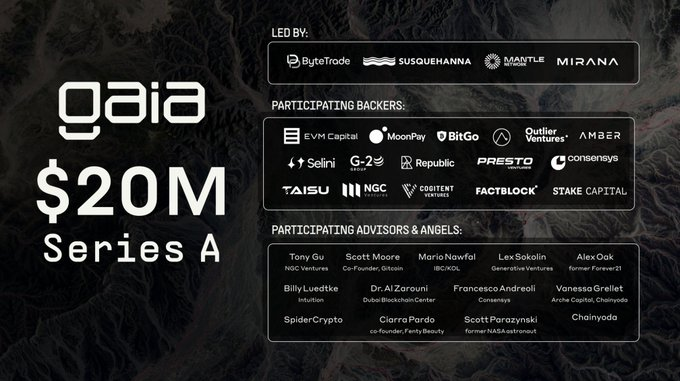
According to blockchainreporter,It recently launched mainnet, onboarding the first external nodes and integrating with Mira Trust Layer for verifiable AI inference. Official docs and SDK are open-source on GitHub, and the developer community spans 20+ countries. GAIA has partnered with Web3 infra projects like Chainlink and The Graph to enrich real-time knowledge feeding and indexing for Agents.
Risk Management & Mitigation
GAIA enforces strict SLA monitoring with penalties and multi-region node distribution to guarantee service quality. It dynamically adjusts staking thresholds and incentive rates, and uses multisig and bug-bounty programs to bolster security.
Future Roadmap
GAIA will roll out a “domain-as-node” scheme, giving each Agent its own tradable subdomain, and build cross-chain incentive bridges for Ethereum, Polygon, Avalanche, etc. The team plans to adopt zero-knowledge proofs to protect sensitive knowledge bases and deploy a thousand-node network by end-2025, energizing decentralized AI ecosystems.
FAQ
How do I run a node?
Follow the docs: download the WasmEdge node image, configure your model and KB, and stake GAIA tokens to register.
How are Agent call fees calculated?
Fees are dynamically priced by model, compute usage, and latency; paid in GAIA—see your SDK config for rates.
How do I acquire tokens?
Available on PancakeSwap V3 (BSC), Uniswap V3 (Ethereum), and via initial airdrops.
How do I participate in DAO governance?
Lock GAIA in the governance contract to submit proposals and vote on the DAO portal.
Where are the technical docs?
Visit the Docs Center for full guides and SDK examples.
Key Takeaways
GAIA builds a decentralized AI Agent network with custom LLM and KB fusion;
Core architecture: WasmEdge runtime, RAG integration, on-chain SLA reward loop;
Token for staking, service payments, and DAO governance—1 billion total, 170 million circulating;
Mainnet live with Mira Trust Layer integration, expanding Web3 infra partnerships;
Roadmap: cross-chain bridges, domain-as-node, and zk-powered privacy enhancements.

Neason Oliver