

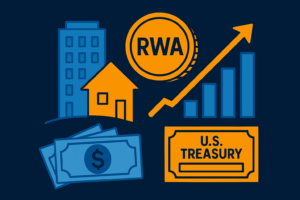
Real-world asset (RWA) tokenization refers to the process of converting ownership rights of tangible assets—such as real estate, U.S. Treasuries, commodities, and private credit—into digital tokens on a blockchain. This innovation allows these traditionally illiquid assets to be traded, fractionalized, and accessed globally through decentralized platforms. In 2025, the RWA sector has surged past $230 billion in market size, with over $12.7 billion in total value locked (TVL) across DeFi protocols. Wall Street’s growing interest stems from the potential to unlock new yield opportunities, improve liquidity, and modernize legacy financial infrastructure.
How RWA Tokenization Works: Legal Wrappers and Blockchain Rails
Tokenizing a real-world asset involves several steps to ensure legal compliance and on-chain functionality. First, the asset is placed within a legal wrapper, such as a Special Purpose Vehicle (SPV), managed by a regulated asset manager and secured by a licensed custodian. The asset’s data—ownership, valuation, and legal status—is verified and linked to a digital token. This token can then be issued on a blockchain, enabling peer-to-peer trading, collateralization, or integration into DeFi protocols. Platforms like Centrifuge and Ondo Finance have pioneered this structure, offering tokenized U.S. Treasuries and private credit instruments to both institutional and retail investors.
Wall Street’s Entry: From BlackRock to Tokenized Treasuries
Major financial institutions are no longer on the sidelines. BlackRock, Franklin Templeton, and JPMorgan have all launched or backed tokenized asset initiatives. The appeal lies in 24/7 market access, automated settlement, and reduced counterparty risk. Tokenized U.S. Treasuries alone have grown to over $5.6 billion in 2025, up from just $700 million in early 2024. These instruments offer stable yields and are increasingly used as on-chain collateral in DeFi lending markets. Wall Street’s embrace of tokenization signals a shift from experimentation to adoption, driven by regulatory clarity and demand for programmable financial products.
Benefits of RWA Tokenization: Liquidity, Access, and Efficiency
Tokenized RWAs offer several advantages over traditional asset management. Fractional ownership allows investors to buy small portions of high-value assets, such as commercial real estate or fine art, lowering the barrier to entry. Blockchain’s transparency and immutability reduce fraud and streamline audits. Additionally, tokenized assets can be traded on decentralized exchanges (DEXs) or integrated into yield-generating DeFi protocols, creating new sources of passive income. Unlike traditional markets, these tokens can be traded 24/7, offering unmatched flexibility and global accessibility.
Use Cases Expanding Beyond Finance
While finance remains the primary domain, RWA tokenization is expanding into supply chain logistics, carbon credits, and intellectual property. For example, tokenized carbon offsets can be tracked and verified on-chain, ensuring environmental claims are legitimate. In the art world, tokenized ownership of physical works enables shared investment and provenance tracking. These applications demonstrate that RWA tokenization is not just a financial innovation—it’s a framework for digitizing trust and ownership across industries.
Infrastructure and Protocols Powering the RWA Boom
Several blockchain platforms are leading the charge in RWA tokenization. Centrifuge enables businesses to tokenize invoices and real-world credit, with integrations into MakerDAO and Aave. Ondo Finance offers tokenized U.S. Treasuries and money market funds, bridging TradFi and DeFi. Maple Finance and Goldfinch focus on undercollateralized lending backed by off-chain assets. These protocols use oracles, legal wrappers, and compliance modules to ensure that tokenized assets remain legally enforceable and economically sound. The convergence of blockchain infrastructure, legal innovation, and institutional capital is rapidly transforming RWAs from a niche experiment into a core pillar of the digital asset ecosystem.
Challenges and Regulatory Considerations
Despite its promise, RWA tokenization faces hurdles. Regulatory compliance varies by jurisdiction, and many tokenized assets still rely on centralized custodians and legal entities. Security is another concern, as tokenized assets are vulnerable to smart contract bugs and custodial breaches. However, initiatives like the GENIUS Act in the U.S. and MiCA in the EU are providing clearer frameworks for compliant tokenization. As legal infrastructure matures, the sector is expected to grow even more rapidly, with Wall Street and DeFi continuing to converge.


Shogun Lin